
The 16-Year Rule: What 34 Years of Charleston Real Estate Data Teaches Us About Wealth
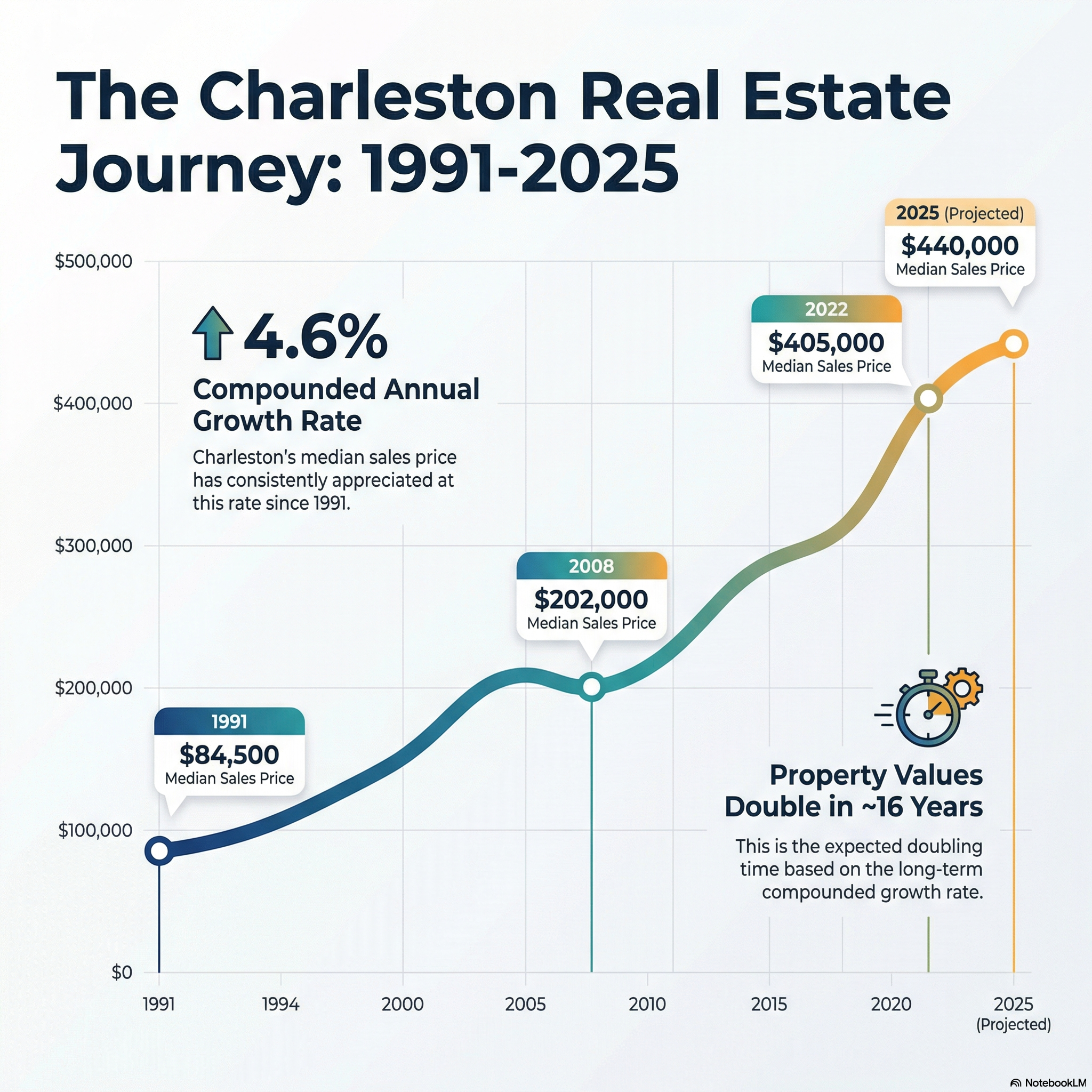
The Rule of 16: At a 4.6% compounded rate, it takes approximately 16 years for your property value to double
.jpg)
The Long Game of Homeownership
Real estate headlines are designed to spark urgency, focusing on the frantic "noise" of weekly interest rate hikes, monthly inventory shifts, and seasonal price dips. For the average observer, this creates a sense of volatility—an impression that the market is a gamble.
However, as a market strategist, I look for the signal within the noise. By analyzing 34 years of comprehensive data for the Charleston tri-county area (Areas 11-78), spanning from 1991 to projected figures for 2025, a different story emerges. The question isn't whether the market is volatile, but whether you have the patience to respect its predictable cycles. The data confirms that for those playing the long game, Charleston real estate is one of the most consistent wealth-building engines in the Southeast.
The Predictable Power of 4.6%
When we apply regression analysis to the median sales price in Charleston over more than three decades, the short-term spikes and valleys vanish, replaced by a remarkably steady upward curve. The data proves a continuously compounded appreciation rate of 4.6%.
This mathematical consistency yields the "Rule of 16." While year-over-year gains fluctuate, the long-term trend remains tethered to this rate, creating a reliable doubling effect.
The Rule of 16: At a 4.6% compounded rate, it takes approximately 16 years for your property value to double.
To see this rule in action, one only needs to look at the historical milestones:
- 1991: The median sales price was $84,500.
- 2007 (16 years later): The price reached $210,000—more than doubling the initial investment despite the looming shadow of the Great Recession.
- 2023 (Another 16 years later): The median price hit $412,000, nearly doubling again.
This isn't a theory; it is a demonstrated historical cycle that has repeated itself twice within our current dataset.
The Myth of the Permanent Crash
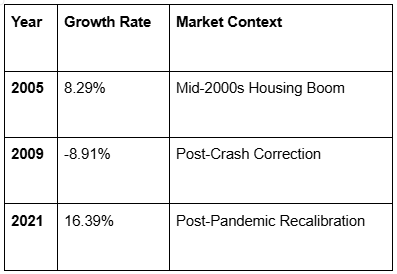
The 2008 crash is the ultimate litmus test for market resilience. For skeptics, the downturn between 2008 and 2011 is proof of risk. During this period, the Charleston market faced a significant -8.91% dip in the median sales price in 2009. However, a strategist views this as a temporary correction rather than a derailment.
By 2013, the median sales price had fully recovered to $209,000, surpassing the pre-crash peak of $204,500 seen in 2006. When viewed through a 34-year lens, the "Great Recession" functions as a minor valley on a massive mountain. With the median sales price on track to reach $440,000 by 2025, the market has more than doubled the values seen during the depths of the 2009 correction.
2021: The Year That Broke the Scales
If 2009 was a historic outlier on the downside, 2021 was a total recalibration of the market's potential. This year did not just represent growth; it represented a fundamental shift in scale.
In 2021, the median price surged by a record-breaking 16.39%. To understand the gravity of that number, compare it to the peak of the mid-2000s "bubble" in 2005, which saw only 8.29% growth. The post-pandemic surge was literally twice as aggressive as the most notorious bubble in modern history.
The Great Inventory Vanishing Act
The engine driving these price surges is a brutal imbalance between supply and demand. This relationship is crystalline when you compare the inventory peak of the crash to the trough of the recent boom:
- The Oversupply Era (2008): As prices fell, average yearly inventory reached a peak of 10,906 units.
- The Trough Era (2021): As prices skyrocketed, inventory collapsed to just 2,014 units.
This represents a staggering 80% reduction in available inventory at a time when demand was at an all-time high. Even with 2025 projections showing inventory recovering to 4,478 units, we remain in a deep supply deficit compared to the 2006–2010 period, where inventory levels consistently sat above 7,700 units.
Conclusion: Looking Toward 2041
The trajectory from 1991 to 2025 confirms that while real estate is subject to cycles, the underlying current is one of relentless growth. Based on the 34-year regression and the Rule of 16, we can look past the current horizon with confidence.
With the median price projected to reach $440,000 in 2025, the strategist must ask: where will we be in the next 16-year cycle? If the 4.6% compounded appreciation rate holds—as it has for over three decades—the Charleston market is on a trajectory to see median prices approaching $880,000 by the year 2041.
The takeaway for the serious investor is simple: wealth in this market is not built on the luck of a single year, but on the disciplined accumulation over sixteen-year cycles. While the noise of the day changes, the data remains constant: time in the market is the only guarantee of a 4.6% compounded win.
Photo Gallery
