
The Charleston Stewardship: A Definitive Guide to Historic Properties
Acquiring a historic residence on the Charleston peninsula is less a standard real estate transaction and more an entry into a lifetime of stewardship

Expert Insight for the Sophisticated Lowcountry Buyer
Acquiring a historic residence on the Charleston peninsula is less a standard real estate transaction and more an entry into a lifetime of stewardship. From the perspective of a property strategist, this requires balancing the undeniable "charm of the past" against the complex technical requirements of a coastal environment.

1. The Heritage Investment: Understanding Designation
Before assessing a property’s potential, a buyer must identify its specific historic designation, which dictates the level of regulatory flexibility:
- National Register Properties: Eligible for substantial tax incentives but subject to the highest preservation scrutiny.
- Local Historic District Homes: Governed by the Board of Architectural Review (BAR); strict guidelines apply to any change visible from the public right-of-way.
- "Contributing" Properties: Essential to the district's fabric; these carry rigorous demolition controls.
Consultant’s Advisory: Your property’s Historic Rating (Category 1–4) is the ultimate arbiter of flexibility. Category 1 & 2 must be preserved in situ at all costs; Category 4 may allow for more contemporary sympathetic additions.
2. Architectural Typologies & Lifestyle Adaptation
Charleston’s vernacular was born of necessity, utilizing narrow lots and sea breezes to mitigate a humid climate.
The Charleston Single House: A Strategic Deep-Dive
- The Design: A narrow gable end faces the street, with a "piazza door" leading not into the house, but onto a side porch (piazza).
- Passive Cooling: Look for a South or West piazza orientation. This captures prevailing sea breezes, acting as a thermal buffer for the interior rooms.
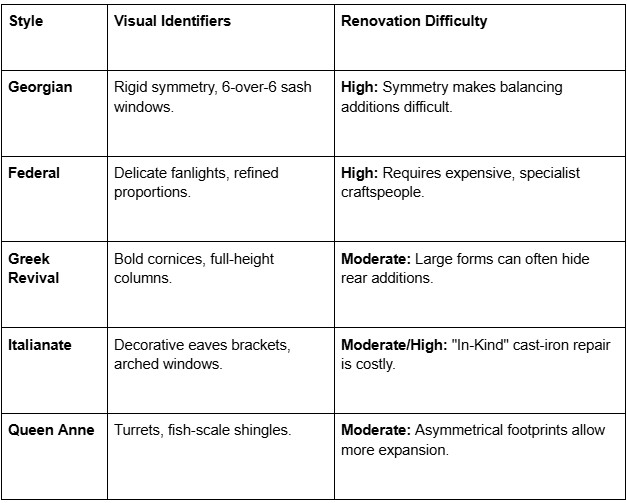
Style Guide & BAR Scrutiny Matrix
3. Navigating the BAR and Easements
The BAR serves as the peninsula's guardian. The "Golden Rule" is the Public Right-of-Way: if a change is visible from a street, sidewalk, or alley, it falls under their jurisdiction.
- The "Hard No" List: Vinyl windows, synthetic siding, and commercial roofing are non-starters.
- Liability Warning: Buyers are legally liable for "Unapproved Past Work." If a previous owner installed unauthorized windows, you may be forced to spend $30,000+ to replace them.
- Preservation Easements: Held by organizations like the Historic Charleston Foundation, these can protect interiors (staircases, plasterwork) and include archaeological restrictions for sub-surface work.
4. Environmental Realities & The 50% Rule
Charleston’s low-lying geography introduces high-stakes variables that can derail an investment.
The FEMA 50% Rule: A Financial Cliff
If renovation costs exceed 50% of the building’s market value (excluding land), the entire structure must meet current flood code.
- The Impact: This typically triggers a physical elevation project costing $200,000+.
- The Double-Bind: Elevation requires BAR approval. Modern engineering needs (flood vents) must be balanced against aesthetic preservation.
5. Financial Strategy: Incentives & Mortgages
Financing a historic asset requires a sophisticated approach. Traditional lenders may see higher risk; seek "preferred lenders" familiar with historic appraisals.
- SC Homeowner Tax Credit: A 25% state income tax credit for rehab expenses over $15,000.
- The 36-Month Rule: Qualifying expenses must occur within a 3-year window.
- Prior Approval: SHPO approval is required before work begins.
- The Mortar Distinction: Never use Portland Cement on historic brick. It is too rigid and will cause bricks to "spall" (shatter). You must budget for specialized lime-based mortars.
6. The Pre-Offer Red Flag Audit
Before making an offer, verify the property's evolution using these local resources:
- Sanborn Fire Insurance Maps: Track footprint changes and original materials.
- The Halsey Map: Understand the historic topography of the lot.
- Foundation Check: Look for "rising damp" and standing water in the crawlspace.
- Pest History: The aggressive Formosan Termite is a primary threat; a comprehensive bond history is essential.
Buyer's Quick-Reference Glossary
- CL-100: The SC wood-infestation report required for closing.
- Flemish Bond: A decorative brickwork pattern indicating high-quality masonry.
- Piazza: The signature multi-level side porch of a Single House.
- Rising Damp: Moisture drawn into porous historic brick from the ground.
- Tabby: A historic material made of lime, sand, and crushed oyster shells.
Legal Disclaimer
Notice to Readers and Prospective Buyers: The information provided in this guide is for informational and educational purposes only. It does not constitute legal, financial, architectural, or professional real estate advice. Readers must verify current zoning, flood designations, and historic ratings with the City of Charleston Department of Planning, Preservation, and Sustainability. Qualification for tax credits is determined solely by the SHPO and the IRS; no work should be commenced prior to receiving written approval. Consult with a licensed South Carolina real estate attorney and a qualified preservation consultant before finalizing any transaction involving a historic asset.
Photo Gallery
